Latin America Geopolitics Explained: US vs China Influence, Argentina, Brazil, Mexico Strategy Analysis
For more than a century, Latin America’s place in global diplomacy appeared relatively stable. The region was largely understood through the prism of its relationship with the United States, with Washington serving as the dominant political, economic, and security force in the hemisphere. That era, however, is now fading. A new geopolitical map is emerging, and Latin America is no longer a passive arena shaped by one external power alone.
Instead, the region is becoming a contested diplomatic space where the United States, China, Russia, and a range of other actors are all seeking influence. This is not merely a distant contest between major powers. It is a transformation with direct consequences for the political choices, economic alignments, and strategic futures of Latin American states themselves.
Across the region, old alliances are weakening, new partnerships are taking shape, and familiar assumptions about hemispheric order are being challenged. What is unfolding is not a single Latin American response to global change, but a fragmented and highly strategic recalibration. Some governments are moving closer to Washington. Others are deepening ties with Beijing. Some are trying to preserve room for maneuver through non-alignment, while a few are drifting into overt confrontation with the West.
The result is a more divided, competitive, and uncertain Latin America — one whose diplomatic choices will shape not only the future of the region, but also wider global politics.
The New Alliances: Competing Models of Influence
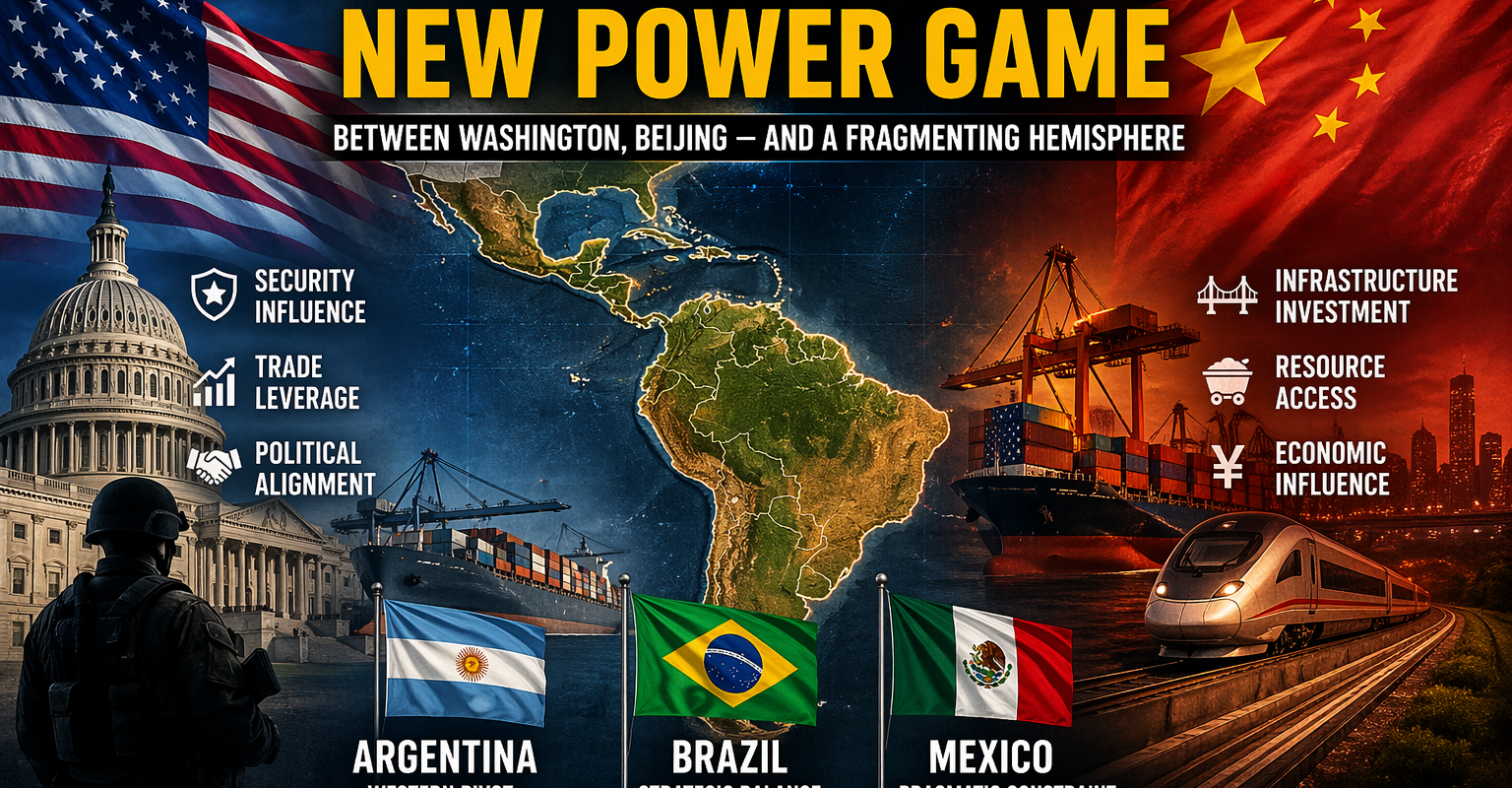
At the center of Latin America’s diplomatic transformation is the intensifying competition between the United States and China. Yet this rivalry is not simply a replay of the Cold War. It is a contest between two different models of engagement.
China’s rise in Latin America has been one of the most consequential geopolitical developments of the past two decades. From being a relatively minor actor, Beijing has become a central economic partner for much of the region. Its approach has been pragmatic, commercially driven, and heavily focused on long-term strategic access to raw materials, food supplies, energy resources, and infrastructure.
This relationship is built on complementarity. Latin America provides commodities, minerals, and agricultural exports that China requires. China, in turn, offers manufactured goods, consumer products, financing, and infrastructure investment. This has allowed Beijing to position itself not merely as a distant trading partner, but as an increasingly embedded economic force.
Its influence is especially visible in South America. There, China has sought to become the leading trade partner while expanding its footprint through ports, roads, logistics corridors, mining investments, and strategic infrastructure under the Belt and Road framework. The Chancay megaport in Peru is one of the clearest examples of this ambition. By reshaping trade routes between South America and Asia, such projects give China not only commercial leverage, but also long-term geopolitical relevance in the region.
At the same time, Beijing has been particularly active in sectors tied to the global energy and technology transition. Its focus on lithium, copper, and other critical minerals reflects a strategic effort to secure inputs essential for future industrial competition. Latin America, with its vast natural resource wealth, has therefore become central to China’s broader global ambitions.
The United States, meanwhile, is responding with a very different playbook. Washington’s strategy has been more heavily rooted in security, migration management, ideological alignment, and the preservation of traditional influence, especially in Central America and the Caribbean. Rather than matching China project for project across South America, the U.S. has concentrated on reinforcing its dominance in areas geographically and politically closest to its own borders.
This includes deeper security cooperation, anti-trafficking frameworks, migration-related pressure, and efforts to curb or counter Chinese strategic presence in sensitive locations such as the Panama Canal zone. In effect, the hemisphere is being shaped by two overlapping but distinct spheres of external engagement: an economically China-facing South, and a security-sensitive North where U.S. power remains more deeply entrenched.
Latin American countries are not responding uniformly to this shift. Some are adapting pragmatically, seeking benefits from both sides. Others are making far more explicit choices. This is where the diplomatic map begins to fracture.
Epicenters of Conflict: Old Disputes, New Risks
While great-power competition is reordering the region from above, Latin America’s own unresolved disputes continue to threaten stability from within. One of the most serious flashpoints is the Venezuela-Guyana dispute over the Essequibo region.
This is not a new conflict. The dispute stretches back more than a century. But recent oil discoveries have transformed it from a historical territorial issue into a live strategic crisis. Essequibo represents around two-thirds of Guyana’s territory and sits close to offshore zones of enormous energy significance. As Guyana’s oil boom accelerates, the stakes have become dramatically higher.
Venezuela’s renewed efforts to assert sovereignty over the territory have raised fears of escalation. Guyana, for its part, has sought support from international law and from friendly powers in the region and beyond. What makes the situation particularly dangerous is that it now combines old nationalism, new energy wealth, and a wider geopolitical environment already marked by fragmentation and mistrust.
If the dispute intensifies, it could destabilize not only bilateral relations but also the wider northern arc of South America. It is a reminder that Latin America’s diplomatic future is not being shaped only by foreign powers. It is also being shaped by unresolved territorial and ideological tensions within the region itself.
A different but equally revealing case is Nicaragua. Under Daniel Ortega, the country has moved sharply away from Western democracies and toward a more openly anti-Western posture. The Ortega government’s suppression of dissent and democratic freedoms has already isolated it from many traditional partners. In response, Managua has increasingly embraced relationships with actors hostile to the West, including Russia, Iran, and other authoritarian states.
This posture is more than rhetorical. It reflects a deliberate reorientation of Nicaragua’s diplomatic identity. Rather than seeking reintegration into the liberal international order, the Ortega regime appears willing to sacrifice traditional partnerships in favor of ideological resistance and regime survival. In doing so, Nicaragua has become a symbol of how democratic erosion inside Latin America is interacting with the wider global realignment.
Three Countries, Three Diplomatic Paths
No analysis of Latin America’s new geopolitical landscape is complete without looking closely at its three major powers: Argentina, Brazil, and Mexico. Each represents a different foreign policy model, and each offers a different answer to the question of how Latin America should position itself in a fragmenting world.
Argentina: A Western Realignment
Argentina has undergone one of the sharpest foreign policy shifts in the region. Under President Javier Milei, Buenos Aires has moved decisively toward the United States and the broader Western camp. This is not a subtle adjustment. It is an ideological and strategic break from the more ambiguous or diversified diplomacy of previous governments.
Milei’s foreign policy has signaled strong support for the U.S., liberal democracies, and Western security structures. His openness toward NATO partnership and his rejection of BRICS reflect a clear desire to reposition Argentina within a Western geopolitical framework. In doing so, Argentina is betting that alignment with Washington and its allies will deliver political legitimacy, economic opportunity, and strategic benefits.
This approach, however, also carries risks. It reduces Argentina’s diplomatic flexibility in a region where multiple powers are competing for influence, and where many states still prefer some degree of strategic autonomy.
Brazil: Strategic Autonomy and Regional Leadership
Brazil offers the opposite model. Under President Luiz Inácio Lula da Silva, Brasília has sought to revive a foreign policy based on strategic autonomy, regional leadership, and global balancing. Rather than choosing between Washington and Beijing, Brazil aims to maintain ties with both while preserving room to act independently.
This is consistent with Brazil’s long-standing aspiration to be more than a regional power. It seeks recognition as a global actor capable of speaking for the Global South, shaping multilateral institutions, and leading regional integration efforts. Lula’s diplomacy reflects this ambition. Brazil remains deeply engaged with BRICS, values its relationship with China, and at the same time keeps channels open with the United States and Europe.
In many ways, Brazil is trying to prevent Latin America from becoming merely an arena for external competition. It wants the region to act with greater collective confidence and political weight. Whether it can achieve that goal remains uncertain, but Brazil’s balancing strategy is central to the region’s future.
Mexico: Pragmatism Under Constraint
Mexico’s position is different from both Argentina and Brazil. Its foreign policy is constrained above all by geography. No Latin American country is more deeply tied to the United States economically, socially, and strategically. Trade, migration, security, and supply chains bind Mexico to Washington in ways that leave little room for grand geopolitical independence.
As a result, Mexico’s diplomacy is defined less by ideological alignment and more by constant negotiation. It must manage tensions with the United States while protecting its own economic interests and preserving a degree of political dignity. Unlike Argentina, Mexico is not pursuing an openly Western ideological realignment. Unlike Brazil, it does not enjoy the same level of freedom to operate as an autonomous global player.
Mexico therefore represents a third model: pragmatic interdependence. Its priority is not to reshape hemispheric order, but to survive and function effectively within the realities imposed by its relationship with the United States.
A Region Without One Center
What is emerging across Latin America is not a single regional doctrine, but a mosaic of competing strategies. Argentina is aligning more openly with the West. Brazil is attempting to lead through balance and autonomy. Mexico is managing dependence through pragmatism. Venezuela and Guyana remain locked in a dangerous territorial confrontation. Nicaragua is sinking deeper into anti-Western isolation. Across South America, China’s economic pull continues to expand, while the United States remains determined to defend influence where it matters most to its own security priorities.
This means that the era of one dominant diplomatic center in the hemisphere is effectively over. Latin America is no longer defined by one overarching alignment. Instead, it is being reshaped by overlapping power contests, internal fractures, economic necessity, and ideological divergence.
That makes the region more dynamic, but also more fragile.
Conclusion
Latin America’s diplomatic landscape is more fragmented and competitive today than it has been in generations. The old model of hemispheric order, dominated by a single power and a relatively predictable set of alliances, is being replaced by a far more fluid and contested reality.
In this new environment, countries are making choices based not only on ideology, but also on economic survival, strategic opportunity, and domestic political calculation. The United States and China are the principal external players, but they are not the whole story. Regional powers, internal disputes, and regime-level choices are all contributing to the reshaping of the continent.
The real question is not whether Latin America is changing. It clearly is. The deeper question is what kind of geopolitical space it is becoming. Will the new competition generate greater autonomy, investment, and diplomatic relevance for the region? Or will it intensify divisions, fuel instability, and draw Latin America into conflicts shaped by outside powers?
The answer will define the next decade — not only for Latin America, but for the wider global order as well.