India’s Growing Strategic Bridge to Latin America: Energy, Trade, and the New Global South Equation
Why Latin America Matters More to India Than Ever Before
For decades, Latin America’s place in global geopolitics was interpreted through a familiar and limited framework. The region was often discussed in relation to the United States, or in terms of its trade links with Europe and, more recently, China. India rarely featured as a central actor in that conversation. That reality is now changing.
A new map of global influence is emerging, and in that shifting landscape India is building a quiet but increasingly consequential strategic presence across Latin America. This is not a symbolic diplomatic expansion, nor merely a commercial outreach. It reflects a deeper change in the logic of international relations, where regions once viewed through old hierarchies are now forming new partnerships based on mutual interest, strategic diversification, and shared developmental priorities.
The India–Latin America relationship is beginning to stand out precisely because it does not follow the older patterns of domination or dependency. Instead, it is rooted in a more pragmatic and balanced vision: one that links energy security, critical minerals, trade, pharmaceuticals, technology, and Global South cooperation into a broader strategic framework. Bilateral trade has already risen to around $45 billion in fiscal year 2023–24, and the trajectory suggests this relationship is moving from potential to substance.
This shift matters not only for the future of India’s external engagement, but also for the future of Latin America itself. As countries across the region seek to diversify beyond traditional partners, India is increasingly seen as a credible, non-hegemonic, and opportunity-rich partner. The result is the gradual emergence of a strategic bridge between two dynamic parts of the world that have often been politically sympathetic, but historically underconnected.
The central question, then, is no longer whether India and Latin America have common ground. They clearly do. The more important question is how this growing relationship will shape trade, energy resilience, technological cooperation, and the wider balance of power in the Global South.
A South–South Strategy: India’s Distinctive Approach to Latin America
The defining feature of India’s engagement with Latin America is that it is not built around coercion, bloc politics, or great-power pressure. India’s approach is rooted in the idea of South–South cooperation—a framework that emphasizes partnership, mutual respect, shared development, and long-term capacity-building rather than extraction alone.
This makes India’s entry into Latin America qualitatively different from many older external power relationships in the region. India is not approaching Latin America as a strategic backyard, nor only as a commodity source. It is engaging with the region as a set of sovereign partners whose economic strengths, political weight, and resource base are increasingly important in a fragmented and multipolar world.
Economically, India has already become a serious actor. Trade with Latin America and the Caribbean has expanded rapidly, touching nearly $50 billion in recent years, with projections suggesting that it could move significantly higher if existing negotiations, sectoral cooperation, and logistics alignment continue to improve. The relationship is built on real complementarity. Latin America brings to the table natural resources, agricultural strength, energy reserves, and critical minerals. India brings scale, industrial demand, pharmaceuticals, automobiles, chemicals, digital capability, and a growing appetite for deeper strategic partnerships.
India’s strategy is therefore not abstract. It is selective, targeted, and highly practical. Its Preferential Trade Agreement with the Mercosur bloc—covering Brazil, Argentina, Paraguay, and Uruguay—already provides a structured base for tariff reduction and trade expansion. At the same time, India is looking beyond formal trade arrangements and focusing on strategic sectors that will define the next phase of global competition: energy, minerals, food systems, public health, and technology.
That is why India’s growing presence in Latin America should not be seen merely as part of normal economic globalization. It is better understood as part of India’s effort to build diversified supply chains, strengthen economic resilience, and deepen ties with regions that matter to the future of a multipolar order.
On the Latin American side too, the logic is compelling. Many countries in the region are looking for ways to reduce overdependence on a narrow set of partners. India offers them a large and expanding market, a development partner with democratic legitimacy, and a country whose rise does not automatically translate into domination. This is one of the main reasons India’s image in the region has gained credibility over time, especially through initiatives such as vaccine diplomacy, pharmaceutical access, and a broader posture of engagement among equals.
The Real Epicenters of Cooperation: Energy, Health, and Critical Minerals
If one looks closely at the India–Latin America relationship, three sectors emerge as the real engines of long-term strategic convergence: energy security, healthcare, and critical minerals. These are not incidental areas of cooperation. They are central to how India sees its future, and to how Latin America can position itself in that future.
Energy Security: Diversifying Beyond Traditional Dependence
India’s energy vulnerability is a structural reality. As the world’s third-largest oil importer, it must constantly think in terms of resilience, diversification, and long-term supply security. In that context, Latin America is becoming increasingly relevant.
India has been deepening or exploring energy ties with countries such as Brazil, Guyana, Venezuela, and Mexico. Each of these relationships reflects a broader strategic calculation. Brazil is an established major player with a growing energy profile. Guyana is one of the most important new oil stories in the world. Venezuela, despite sanctions-related complications and political volatility, remains home to enormous reserves. Mexico, though constrained by its own domestic and geopolitical realities, remains a substantial economic partner in the region.
What matters here is not simply that India wants to buy more oil. The larger point is that India cannot afford overdependence on a narrow geography, especially at a time when conflict in the Gulf, instability in shipping routes, and great-power tension can create serious supply shocks. Latin America offers India a way to build an energy architecture that is broader, more resilient, and less exposed to a single regional crisis.
In other words, India’s energy engagement with Latin America is not transactional. It is strategic insurance.
Healthcare and the Power of Indian Pharmaceutical Diplomacy
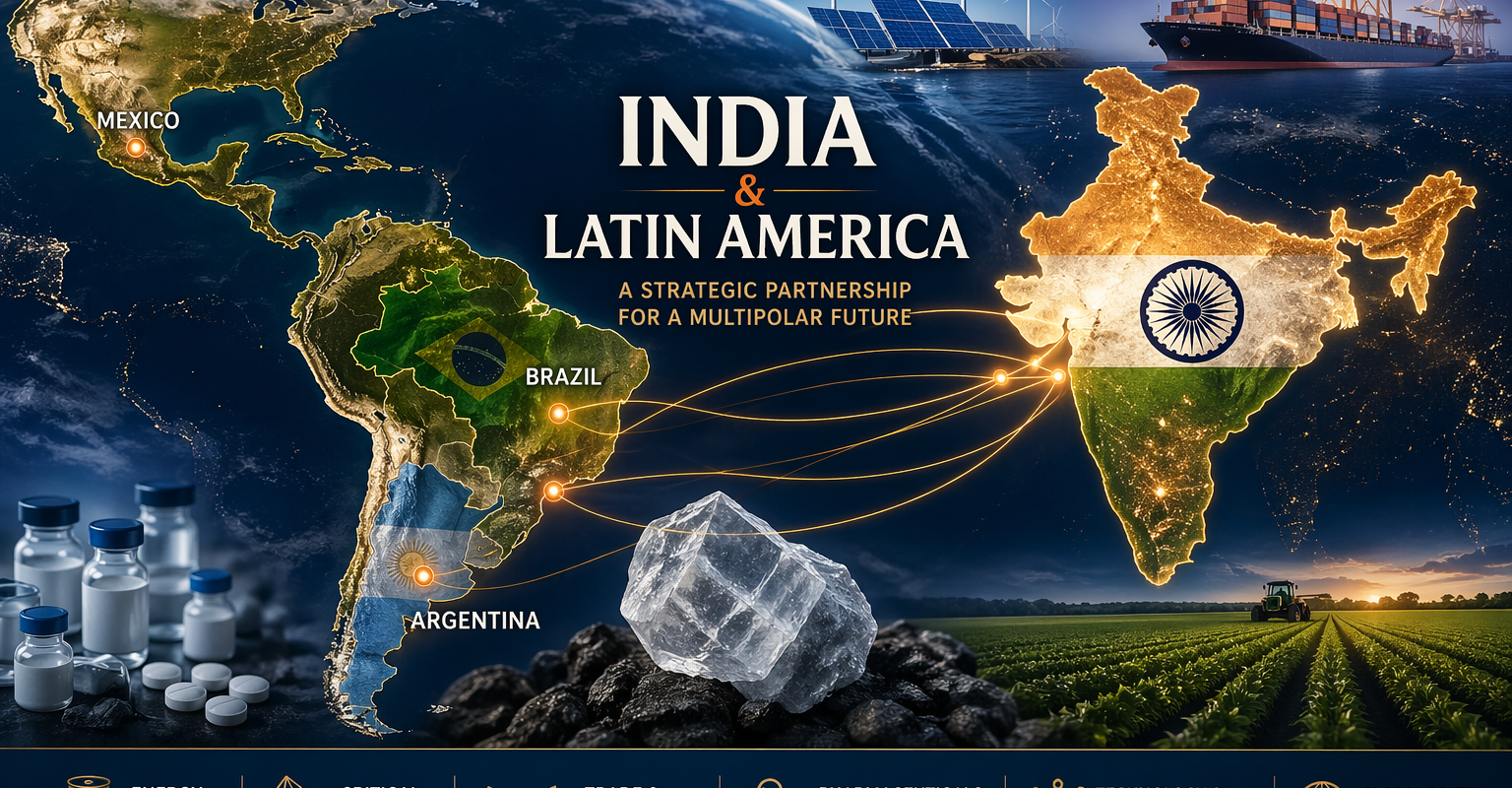
A second major pillar of the relationship is healthcare. India’s identity as the “pharmacy of the world” has found strong relevance in Latin America, where affordable medicines, vaccines, and public-health access remain vital priorities. Indian pharmaceutical exports to the region have expanded steadily, with countries such as Brazil, Mexico, Chile, and Peru becoming important markets.
This is not merely a trade story. It is also a diplomacy story.
Indian generic medicines and vaccine supplies have helped lower healthcare costs and expand treatment access, including in areas such as HIV and cancer care. During the COVID-19 pandemic, India’s Vaccine Maitri initiative reinforced the idea that India could be a reliable and responsive partner in times of global stress. That trust did not disappear after the pandemic. It remains an important part of India’s image in the region and strengthens the larger political foundation of the relationship.
This form of health diplomacy has a strategic significance that goes beyond goodwill. It gives India a practical and people-facing relevance in Latin America—something that commodity trade or diplomatic declarations alone cannot achieve.
Critical Minerals: The Lithium Imperative
The third major pillar is critical minerals, especially lithium. Here, the India–Latin America relationship takes on an even more future-oriented dimension.
Argentina sits at the heart of the so-called Lithium Triangle, one of the world’s most important resource zones for the batteries that will power electric vehicles, storage systems, and much of the next industrial cycle. India’s move to secure access to lithium blocks in Argentina through a public sector agreement worth around $24 million marked a major strategic step. It showed that India is no longer content to remain dependent on others for upstream access to future-defining resources.
This is particularly important because the global race for critical minerals is already deeply geopolitical. Access to lithium is not just about energy transition—it is about industrial competitiveness, technological sovereignty, and the ability to shape manufacturing ecosystems in the decades ahead.
For India, therefore, Argentina is not just another trade partner. It is part of a longer game: securing the material foundations of a greener and more technologically ambitious future.
Three Key Relationships, Three Strategic Pathways
Within Latin America, not all countries matter to India in the same way. The regional map is too diverse for a one-size-fits-all approach. Three countries in particular—Brazil, Argentina, and Mexico—illustrate the different kinds of partnerships India is building across the hemisphere.
Brazil: India’s Most Important Strategic Partner in the Region
If one country stands out as India’s top-tier partner in Latin America, it is Brazil. The India–Brazil relationship has a depth that goes beyond commerce. Elevated to a Strategic Partnership in 2006, it is built on shared democratic values, converging views on multipolarity, and sustained cooperation in forums such as BRICS, IBSA, and the G20.
Brazil is India’s largest trading partner in Latin America, and both sides have set ambitious goals to expand bilateral trade even further. But the real value of the relationship lies in its breadth. It spans defense cooperation, agricultural exchange, space collaboration, technology, and especially bioenergy. India’s launch of Brazil’s Amazonia-1 satellite symbolized a level of trust and technological cooperation that few bilateral relationships can easily claim.
Under President Lula da Silva, Brazil has once again emphasized Global South leadership and strategic autonomy—an outlook that aligns naturally with India’s worldview. This makes the India–Brazil partnership more than just regionally important. It is one of the key relationships shaping how developing democracies can cooperate in a world no longer dominated by a single center of power.
Argentina: From Opportunity to Strategic Resource Partnership
Argentina represents a different but equally important pathway. Its value to India lies less in broad geopolitical alignment and more in the strategic relevance of its resources.
India’s relationship with Argentina is increasingly being defined by two imperatives: critical minerals and food security. The most visible driver is lithium. India’s entry into Argentina’s lithium sector marks a new phase in the relationship, where resource access and future industrial planning become central. But this is only part of the story. Argentina’s agribusiness sector also matters to India, especially in areas such as edible oils and pulses.
This makes the partnership highly pragmatic. It is built around securing what India needs for long-term growth rather than around ideological alignment. That in itself is not a weakness. In fact, it may give the relationship a level of clarity and durability that more rhetorical partnerships often lack.
Argentina is therefore emerging not just as a promising partner, but as a country that can serve directly and materially in India’s energy-transition and food-security agenda.
Mexico: A Major Economic Link Shaped by Structural Constraints
Mexico occupies yet another category. It is India’s second-largest trade partner in Latin America, and the relationship is driven primarily by economics, investment, and manufacturing linkages. Trade has crossed major thresholds, Indian exports of vehicles and pharmaceuticals have expanded, and more than 200 Indian companies have established a presence in Mexico, especially in IT and auto components.
Yet Mexico’s foreign economic environment is shaped by its deep integration with the United States. That creates opportunities, but also constraints. Unlike Brazil, Mexico’s external economic options are filtered through a geography and trade architecture that are heavily influenced by North America. Recent tariff measures affecting imports from non-FTA partners underscore the kinds of structural obstacles that can arise. India’s proposal for a preferential trade arrangement reflects an understanding that economic potential alone is not enough; it must be institutionally protected if it is to grow.
The India–Mexico relationship may not carry the same geopolitical symbolism as India–Brazil, but its economic significance is undeniable. It offers scale, industrial connectivity, and a gateway into broader manufacturing ecosystems.
Why This Partnership Matters in the Emerging Global Order
The India–Latin America relationship is becoming important at a time when the global system is visibly under strain. Supply chains are being rethought. Energy flows are vulnerable. Strategic minerals are becoming instruments of power. Public health remains tied to questions of industrial capacity and affordability. At the same time, many countries across the Global South are searching for models of cooperation that do not force them into hard alignments.
This is where the India–Latin America equation becomes especially significant.
India’s engagement with the region is not based on military pressure. Nor is it based on ideological export. It is rooted in a more practical proposition: that two major regions of the developing world can work together on the basis of complementarity, diversification, and mutual benefit. Latin America has the resources, agricultural capacity, and regional weight. India has scale, markets, industrial demand, pharmaceutical capability, technology, and growing diplomatic reach.
That combination creates the possibility of something larger than bilateral trade growth. It creates the possibility of a new strategic bridge within the Global South.
At the same time, realism is necessary. Latin America is not a single bloc. Regional tensions, domestic political changes, economic crises, and shifts in external pressure can all complicate long-term engagement. For India, this means its diplomacy must remain flexible, country-specific, and strategically calibrated. Brazil cannot be approached like Argentina. Argentina cannot be approached like Mexico. And all three must be understood within their own domestic and geopolitical constraints.
But this complexity is not a reason for disengagement. It is precisely why early and intelligent engagement matters.
Conclusion: A Strategic Relationship Whose Time Has Come
India’s growing relationship with Latin America is no longer a diplomatic side note. It is becoming a serious component of India’s external strategy and a meaningful part of Latin America’s own search for diversified partnerships.
Brazil is emerging as a strategic ally and a fellow voice of the Global South. Argentina is becoming central to India’s resource security and future-facing industrial needs. Mexico remains a vital trade and investment partner with enormous economic relevance. Across the wider region, India’s presence in pharmaceuticals, energy, trade, and technology is generating forms of cooperation that are practical, durable, and politically significant.
What is taking shape, then, is not just a series of bilateral exchanges. It is the outline of a wider geopolitical shift. A relationship once seen as peripheral is now acquiring strategic depth.
The more serious question is no longer whether India and Latin America should work together. That case is already strong. The real question is how far and how fast they can convert this momentum into a deeper, long-term partnership that reshapes the economic and political architecture of the Global South.
That answer will not be written in a single summit or trade figure. It will be written over the next decade—in oil flows, lithium contracts, pharmaceutical networks, digital cooperation, and the strategic choices both sides make in a more fragmented world.
For HispanicIndia
If you follow geopolitics through the lens of India, Latin America, Europe, and the emerging Global South, this is exactly the relationship to watch.
And the question for readers is simple:
Which pillar of India–Latin America cooperation will matter most in the next decade—energy, critical minerals, trade, pharmaceuticals, or technology?