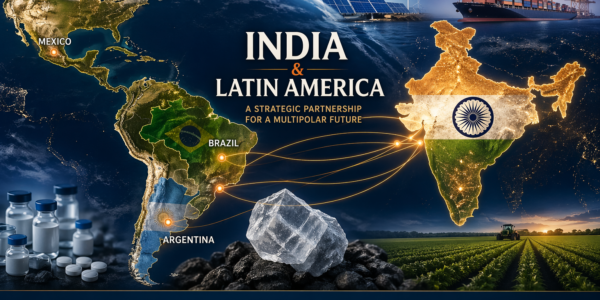
The Global South Energy Pivot: India, Venezuela, and the Search for Options
Strategic Context: India’s Energy Security Imperative
As of mid-2026, global energy markets have been shaken by severe supply shocks, forcing a brutal recalibration of procurement strategies for major energy consumers.
For India, the world’s third-largest oil importer and consumer, the question of securing consistent crude flows has moved beyond price optimization. It has become a strategic imperative.
This shift is most visible in India’s renewed engagement with the Venezuelan energy corridor. After a period in which Indian imports of Venezuelan crude were disrupted by sanctions volatility, Venezuelan oil has re-entered India’s energy basket with significant force.
The India–Venezuela relationship should not be read merely as a tactical oil purchase. It is part of a wider Global South energy calculation, where New Delhi is trying to secure supply options beyond traditional chokepoints and sanction-sensitive corridors.
The partnership has historical depth. Indian public sector undertakings, especially ONGC Videsh Ltd., have long-standing exposure to Venezuela’s energy sector. What has changed in 2026 is not the existence of the relationship, but the urgency surrounding it.
India’s domestic energy demand, the disruption of West Asian maritime routes, and the partial opening created by US sanctions easing have together pushed Venezuela back into India’s strategic energy conversation.
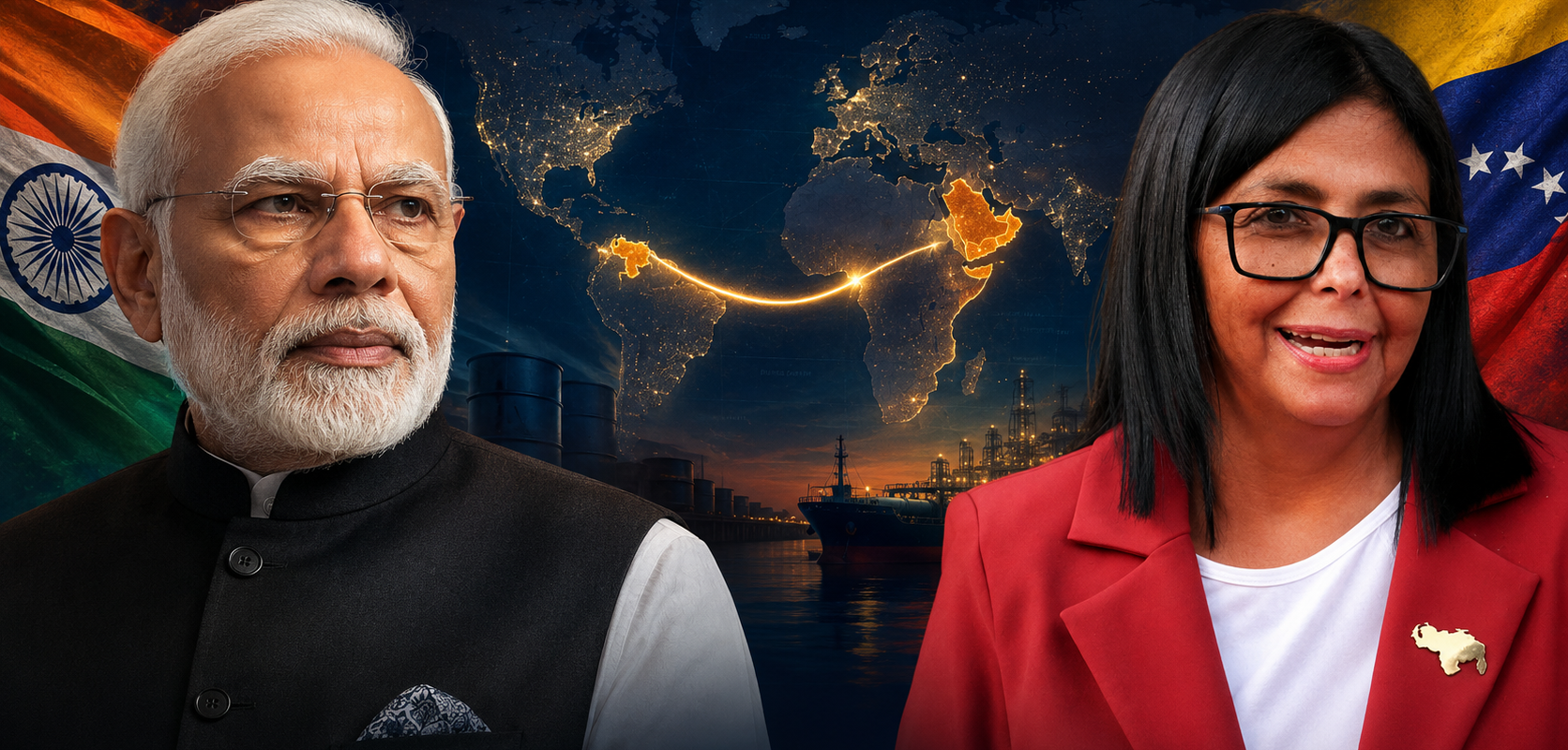
The surface story is Delcy Rodríguez’s visit to India. The deeper story is India’s search for energy optionality in a fractured global order.
Geopolitical Catalyst: The Strait of Hormuz Disruption
In maritime geopolitics, the disruption of a primary chokepoint is never a routine event.
The Strait of Hormuz has long been one of the most critical arteries for global energy flows. For India, the disruption has direct consequences because a large share of its crude imports traditionally passes through this route.
The ongoing conflict around Iran and the resulting disruption near Hormuz have forced Indian refiners to look more aggressively toward alternative suppliers in Latin America and Africa.
This is where Venezuela becomes strategically relevant again.
For Indian refiners and energy public sector undertakings, the Venezuelan corridor is no longer a distant or occasional option. It has become part of a forced operational reorientation.
The consequences of the Hormuz disruption can be seen in three areas:
- Equity-Based Supply Security: Indian PSUs have an incentive to revisit existing equity-linked energy relationships, including those connected with ONGC Videsh Ltd. in Venezuela. Equity participation can matter more during disruption because it offers a deeper commercial and strategic link than spot purchases alone.
- Infrastructure Stress: Indian refineries must maintain flexibility to handle different crude grades. Venezuelan crude is not a perfect substitute for every West Asian supply stream, but India’s refining system has long adapted to a diverse crude basket.
- Diversification Mandate: The disruption has weakened the comfort of just-in-time procurement from traditional suppliers. For India, diversified long-haul supply corridors are not a luxury. They are part of energy resilience.
The Hormuz crisis did not create India–Venezuela energy ties. But it has made them far more strategically visible.
The US Factor: Sanctions Relief and the Rubio Framework
The US factor is central to this story.
Indian purchases of Venezuelan oil resumed after US sanctions were eased in February 2026 under a Washington-Caracas oil supply arrangement. The framework reportedly allows Venezuelan oil exports while proceeds are managed through US Treasury-administered bank accounts.
This creates a complicated opening.
On one side, it allows Indian refiners to access Venezuelan crude at a time when alternative supplies are urgently needed. On the other side, it keeps Washington at the centre of the financial architecture.
This is why the Rubio framework, or Rubio line of policy, matters. US Secretary of State Marco Rubio publicly indicated that Venezuelan oil could become part of the energy conversation with India. But this facilitation does not eliminate risk. It restructures risk.
For India, the strategic caveat is clear:
If payments, proceeds, or approvals remain dependent on US-administered channels, Washington retains significant leverage over the flow of money and the durability of the trade.
That creates a single-point vulnerability. India may benefit from the current opening, but it cannot ignore the possibility of future sanction whiplash.
| Feature | Previous Sanctions Environment | Current Facilitated Trade Framework, June 2026 |
| Import Status | Disrupted; Indian purchases had fallen sharply or stopped | Renewed and rising imports amid supply disruption |
| Tariff and Pressure | High uncertainty and restricted channels | Eased framework enabling renewed trade |
| Financial Oversight | Severe transaction constraints | Proceeds reportedly managed through US Treasury-administered accounts |
| Strategic Character | Maximum pressure and isolation | Conditional facilitation with continuing US leverage |
The key point is this: The Venezuelan corridor gives India options, but not complete freedom from geopolitical risk.
Leadership Transition: The Delcy Rodríguez Factor
The stability of the current energy bridge also depends on the political configuration in Caracas.
Following the January 2026 capture and prosecution of Nicolás Maduro by the United States, Delcy Rodríguez emerged as Venezuela’s acting leader. Her position has provided continuity at a moment when Venezuela’s domestic and external politics remain deeply unsettled.
For India, Rodríguez is not an unknown figure.
This is her sixth visit to India. She previously visited as Foreign Minister (2015) and as Vice President (2019, 2023, 2024, 2025). This repeated access signals institutional familiarity and diplomatic continuity.
Rodríguez also carries a cultural layer. She has been associated with the Sri Sathya Sai Baba tradition and has visited the Sai Baba ashram in India. This adds a softer background of personal familiarity, though energy and investment remain the main drivers.
Rodríguez’s acting status has also partially decoupled the energy conversation from the political fate of the Maduro regime. That does not remove the political risk, but it creates a workable channel for the moment.
Quantitative Analysis: Venezuela’s Surge in India’s Import Basket
The trade data for May 2026 confirms a sharp shift.
India reportedly purchased 427,000 barrels per day of Venezuelan oil in May 2026, making it one of the most important buyers of Venezuelan crude during that period.
This volume is significant, as it coincides with severe pressure on West Asian supply routes. India is using the available opening to diversify supply.
While oil flows can change quickly depending on price, sanctions, and logistics, the May 2026 numbers show that Venezuela has moved from peripheral relevance to immediate strategic utility in India’s energy basket.
If Venezuelan crude can enter India’s supply mix at scale during a Hormuz disruption, then Latin America becomes part of India’s emergency energy architecture.
The June 2026 Delegation: Beyond the Oil Barrel
The delegation led by Acting President Delcy Rodríguez from June 03 to June 07 is not only about oil. It is being tested across multiple sectors.
Rodríguez is accompanied by ministers responsible for: Foreign Affairs, Economy and Finance, Science and Technology, Communication and Information, and Transportation.
The official agenda covers: Energy security, trade and investment, pharmaceuticals, healthcare, transportation, renewable energy, and industrial technology.
The primary litmus test for the success of the visit remains the settlement of legacy energy-sector issues, especially the reported unpaid dividends owed to ONGC Videsh Ltd. Without that, new capital expenditure will remain difficult.
The Global South Frame
India and Venezuela both speak the language of the Global South, but their needs are different. This relationship engagement fits into a marketplace of bargaining power.
India wants strategic autonomy, diversified energy corridors, and a multipolar world.
Venezuela wants energy buyers, economic partners, technology access, and relevance.
This engagement is not India joining a camp; it is India keeping options open.
Risk Check: What Should Not Be Overstated
The story must not be exaggerated. This visit does not prove a formal alliance shift, nor does it mean India is abandoning traditional suppliers. The risks remain serious: Sanctions Whiplash, Payment Architecture dependency, Supply Reliability, and complex logistics costs.
The stronger analysis is that India is preserving the Venezuela option.
Final Takeaway
The Indo-Venezuelan bond in 2026 reflects the pragmatism of the Global South. India is not making an ideological bet. It is managing risk, buying options, and widening its strategic map.
Delcy Rodríguez’s India visit may look like a diplomatic formality. It is not. It is a small window into the next phase of India–Latin America engagement.
ABOUT HISPANICINDIA HispanicIndia, promoted by Ravi Kumar, explains the strategic links between India, Latin America, Europe, and the Global South through analysis of diplomacy, trade, energy, technology, and changing global power equations.
SOCIAL CTA For more analysis on India, Latin America, Europe, energy security, trade, diplomacy, and the Global South, follow HispanicIndia and share your view below.
DISCUSSION QUESTION Is India’s engagement with Venezuela a smart energy diversification move, or a risky geopolitical balancing act?